Biocentric Knowledge - The relative biocentric health theory (rBHT)
From egocentric survival to life-oriented health
Climate crisis, wars, rising rates of mental illness: many of the crises of our time share a common root. Human beings have become disconnected from life – from their own bodies, from other people and from nature. The Relative Biocentric Health Theory (rbHT), developed by Prof. Dr. Marcus Stueck, starts here. It asks not only how people can avoid illness, but how life can unfold in a healthy way: in individuals, families, organisations and society (Stueck, 2026a, 2026b).
The roots: Rolando Toro and the biocentric principle
The rbHT stands in the tradition of the Chilean psychologist and anthropologist Rolando Toro Araneda (1924–2010), the founder of Biodanza. The biocentric principle comes from him: the universe exists because there is life, not the other way round. In Toro’s view, it is permeated by a cosmic life energy – a force of love that brings forth connection, diversity and evolution (Toro, 2010). Human beings are not at the centre of the world. Life itself is at the centre, and human beings are part of it.
To make this force tangible, Toro developed Biodanza, a system of human integration through movement, music and encounter in a group. Its core is the vivencia: the immediate experience – felt rather than thought – of being alive in the present moment. It unfolds along five lines of human potential:
• Vitality: the impulse of life and inner balance,
• Sexuality: desire and pleasure,
• Creativity: expression and creative shaping,
• Affectivity: bonding through love, empathy and compassion,
• Transcendence: connectedness with nature and the feeling of being part of the universe.
Toro’s contribution lies less in a theory about the origin of the world than in an affective-ethical consciousness: the lived experience of being connected with all life – felt in dance, in encounter, in love and in nature. This attitude remains the foundation of the rbHT.
Biocentric holism
The rbHT has developed Toro’s approach further. It combines it with three other perspectives on life in a model called biocentric holism (Fig. 1). The model arranges four perspectives along two levels: the manifest level – what is visible, measurable and physical – and the non-manifest level – what is invisible and underlies the visible.
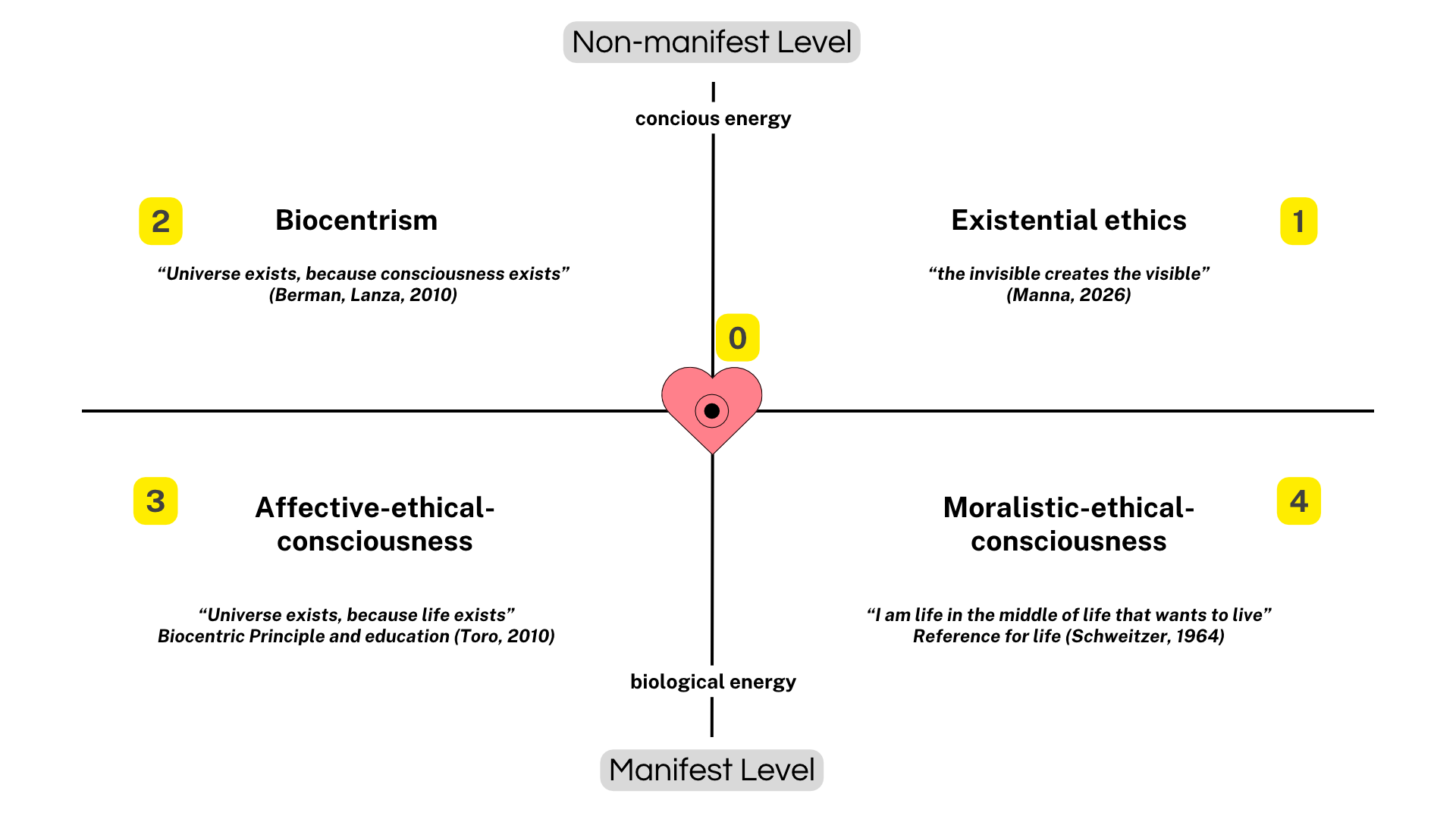
Fig. 1: Biocentric holism – four perspectives on life, connected in the heart as the biocentric core (after Stueck, 2026b)
On the manifest level there are two forms of ethical consciousness:
• (3) Affective-ethical consciousness (Toro): life is felt and lived – in dance, encounter and love. Toro’s life energy remains bound to the biologically visible.
• (4) Moral-ethical consciousness (Albert Schweitzer): reverence for life, in his words: “I am life that wills to live, in the midst of life that wills to live” (Schweitzer, 1966).
On the non-manifest level there are two perspectives that place consciousness at the beginning:
• (2) Biocentrism (Robert Lanza and Bob Berman): the universe exists because consciousness exists; life and consciousness are the keys to understanding reality (Lanza & Berman, 2009).
• (1) Existential ethics (Mariella Manna): the invisible creates the visible; consciousness is a creative energy emanating from a first, uncaused origin (Bazzotti, Manna & Stueck, 2026).
At the centre (0) lies the heart as the biocentric core. This is where both levels meet: the visible and the invisible, body and consciousness. The rbHT calls the movement from the invisible into the visible – the unfolding of life from its source – biospoiesis (see below).
For health, biocentric holism means: health is more than a well-functioning body. It is an expression of our connection with the visible and the invisible orders of life.
Two paths to health
The rbHT distinguishes two complementary forms of health:
• Anthropocentric health: the human being is at the centre. It is about coping with stress, solving problems and creating security – everything that keeps us stable and able to act.
• Biocentric health: life is at the centre. It is about connectedness, presence in the moment and the ability to keep developing.
Both are necessary. The theory illustrates this with an image: the polar bear and the penguin. The polar bear stands for structure and stability – diagnostics, therapy, clear procedures. The penguin stands for experience, encounter and change – dance, meditation, nature. A person becomes healthy when both work together: the polar bear provides solid ground, the penguin opens up the space.
Biospoiesis and thanapoiesis
Everything that lives carries within it the urge to unfold. The rbHT calls this process biospoiesis (Greek bios = life, poiesis = bringing forth). It is not linear growth but a spiral: a living being develops, reaches its limits, enters a crisis and, at best, finds a new balance at a higher level. The theory calls this transition the biospoietic leap. A child learning to walk after many falls, a person finding new joy in life after a loss, a community growing together again after a disaster – all of these are examples of biospoiesis.
Its counterpart is thanapoiesis (Greek thanatos = death): stiffening, contracting and closing off. It, too, belongs to life – withdrawal, rest and farewell are necessary. Health means a living oscillation between both poles. A person or a system only becomes ill when it remains stuck at one pole for a long time – in fear, rigidity or constant defence. The rbHT calls the factors that block the unfolding of life in this way biocentric borders. They can be fears, rigid thought patterns, overload or social structures.
Its counterpart is thanapoiesis (Greek thanatos = death): stiffening, contracting and closing off. It, too, belongs to life – withdrawal, rest and farewell are necessary. Health means a living oscillation between both poles. A person or a system only becomes ill when it remains stuck at one pole for a long time – in fear, rigidity or constant defence. The rbHT calls the factors that block the unfolding of life in this way biocentric borders. They can be fears, rigid thought patterns, overload or social structures.
Forms of biospoiesis
Biospoiesis appears not only in the body but in six forms that run through all of life (Stueck, 2026b):
• Spiritual biospoiesis: connection with a non-material origin, a source of meaning beyond one’s own self.
• Cosmic biospoiesis: the embedding of life in the great rhythms and cycles of the universe – from day and night to the seasons.
• Biocosmic biospoiesis: microcosm and macrocosm – the cell and the universe – as different expressions of the same deeper order.
• Social biospoiesis: life unfolds in relationship – through connectedness, resonance, cooperation and community.
• Societal biospoiesis: cultures and institutions create conditions that protect life, enable participation and respect the ecological limits of the planet.
• Rational biospoiesis: self-reflection, responsibility and the search for meaning help us to work through crises consciously.
Societal and rational biospoiesis are found only in human beings, because both require a reflecting self. Rational biospoiesis carries the greatest risk: without heart intelligence as a counterweight, it becomes intelligence without compassion, knowledge without connectedness and control without vitality. Where the connection succeeds, ways of thinking emerge that serve life – for example Bohmian dialogue, a conversation without judgement in which people find new insights together.
The holographic aspects of life
In a hologram, every fragment contains the whole image. If a holographic plate is broken, each piece still shows the complete picture, only less sharply. The rbHT applies this image to life: every living system, from a single cell to a whole society, carries the same basic features of life. The theory calls them the five holographic aspects.
1. Source – what life draws on. Every living being needs an origin from which it draws strength. In a cell, this is its genetic information. In a person, it is life energy, meaning and the feeling of being connected with something greater. In a community, it is shared values and roots.
2. Connection – exchange with others. No life exists on its own. Cells constantly exchange signals, people need relationships, societies need cohesion. A healthy system is in lively exchange with its environment.
3. Rhythm – oscillating between tension and relaxation. Heartbeat, breath, sleeping and waking, work and recovery: life pulsates. Anyone who is permanently “on” or permanently “off” – in chronic stress or exhaustion, for example – loses their rhythm.
4. Biospoietic leap – the step to a new level. When a system reaches its limits, instability arises – a fork in the road. Either a leap to a new level of development succeeds, or the system stiffens. Crises are therefore not only a threat but also an opportunity.
5. Boundary – protecting while staying open. Every cell has a membrane that protects it and is at the same time permeable. People and communities also need healthy boundaries: clear enough to protect themselves, open enough to let in the new.
How universal these aspects are can be seen in archaea, which are among the oldest living organisms on Earth:
• Source: their ring-shaped genetic information.
• Connection: constant feedback within the cell.
• Rhythm: their cell processes oscillate periodically between activity and rest.
• Biospoietic leap: a mutation through which they adapt to new conditions.
• Boundary: their cell membrane decides what goes in and out.
The same principles can be found in people, families, schools, companies and societies. In the rbHT, the holographic aspects therefore serve as a navigator for health. Instead of looking only at symptoms, we can ask: How is the source? Are the connections alive? Is the rhythm right? Is a developmental leap due? Are the boundaries healthy?
The biocentric core and heart intelligence
The biocentric core is the feeling of simply being there – in the present moment. It has an embodied side, which we feel in the body, and a non-embodied, spiritual side. Both meet only in the here and now. For the rbHT, presence is therefore a basic precondition of health. Its counterpart is the anthropocentric core, the ego.
Heart intelligence: alongside analytical thinking, human beings possess a second form of intelligence – the ability to perceive with the heart. Heart intelligence is embodied, felt knowledge. It arises in relationship – through compassion, resonance and intuition – and is closely connected with the biocentric core. It shows itself when we sense what is right in a moment before we can explain why. Heart intelligence can be practised, for example through presence, stillness, Biodanza or heart meditation. According to the rbHT, it is the capacity that artificial intelligence cannot replace.
The sense of possibility builds on heart intelligence. It is the ability to keep several paths open at the same time instead of deciding too quickly. Out of this openness, a decision “from the heart” can emerge and lead to courageous action. Heart intelligence provides the light; the sense of possibility provides the direction.
Switching points and applied quantum psychology
Switching points are moments and methods through which a person can move from the mode of “control and evaluation” to the mode of “experience and connectedness” – for example through conscious perception, Biodanza, stillness or experiencing nature. The rbHT distinguishes general switching points, which switch between the two modes in principle, and specific switching points, which deepen experience in a targeted way.
Applied quantum psychology: the rbHT uses images from quantum physics as analogies for psychological and social processes. One example is superposition: many possibilities exist at the same time, and only our attention decides which of them becomes reality. Methods such as dualisation (thinking in complementary opposites) and quadlation (arranging a field of possibilities into four fields) help us to understand complex situations and find new ways of acting.
Applied quantum psychology: the rbHT uses images from quantum physics as analogies for psychological and social processes. One example is superposition: many possibilities exist at the same time, and only our attention decides which of them becomes reality. Methods such as dualisation (thinking in complementary opposites) and quadlation (arranging a field of possibilities into four fields) help us to understand complex situations and find new ways of acting.
The spiritual life cycle
The rbHT also asks what life means beyond a single lifetime. It assumes that consciousness is not produced by the brain but precedes it; the brain is understood rather as a receiver and filter. On this basis, and drawing on interviews with the spiritual teacher Mariella Manna (Bazzotti, Manna & Stueck, 2026), it describes a spiritual life cycle in three phases:
1. Outflow: from an original field of all possibilities, consciousness condenses via spirit, essence and soul into embodied life.
2. Cycle of rebirth: at death, the soul returns to the spiritual realm. The essence absorbs the experiences of that life, and a new soul is embodied in a new life. Death is understood not as an end but as a transition: the body passes away, consciousness lives on.
3. Completion: after many lives, consciousness has fully matured, and no further incarnation follows.
According to the rbHT, the meaning of this movement is to become more conscious – through the experiences of a life in a world of opposites. The rbHT calls this movement beyond death spiritual biospoiesis. It is connected with biospoiesis in everyday life – unfolding in body, psyche and relationships. For health, this means: those who experience themselves as part of a greater whole can meet illness, loss and dying differently.
How should this part be understood? The rbHT is not the first scientific theory to address such questions. It stands in a long tradition:
• C. G. Jung described the collective unconscious and the path of individuation.
• Abraham Maslow and transpersonal psychology studied peak experiences and self-transcendence.
• Stanislav Grof researched non-ordinary states of consciousness (Grof, 1985).
• Ken Wilber combined Western psychology and Eastern traditions in an integral theory (Wilber, 1995).
• In reincarnation research, Ian Stevenson and Jim Tucker documented cases of children who reported memories of previous lives; these findings are scientifically contested.
What is new about the rbHT is the attempt to integrate these questions explicitly into a theory of health and to link them with biospoiesis, the holographic aspects and practical health promotion. The rbHT itself marks its statements on the spiritual life cycle as theoretical assumptions: they can be neither proven nor refuted with the methods of natural science. They are not a creed, but an invitation to reflect on life and death within a wider frame.
How is the theory applied?
The rbHT is not purely theoretical. It combines established and new methods:
• in education – with the Master Plan for Healthy Education, the School of Empathy and TANZPRO-Biodanza for children,
• in psychotherapy and health promotion – with stress management, Biodanza, meditation and ego reflection,
• in crisis intervention – for example after natural disasters and in war zones. Here the principle is: stabilise first, then transform.
Research on the rbHT
The rbHT builds on more than 30 years of research on stress, yoga and Biodanza, including studies on stress hormones and the immune system (Stueck et al., 2016; Stueck & Villegas, 2017). Since the COVID-19 pandemic, the theory itself has been investigated empirically. Two lines of research are central.
Germany and Poland: biocentric health during the pandemic (Sebastian Müller-Haugk). In his doctoral thesis in Gdańsk, Sebastian Müller-Haugk applied the rbHT empirically for the first time (Müller-Haugk, 2023). He examined which factors predict anthropocentric and biocentric health during the COVID-19 pandemic and what role previous experience with sport, yoga, meditation and Biodanza plays. The factor “source”, as an expression of the biocentric core, proved significant in all biocentric models, whereas the effects of previous movement experience were small. In a German–Polish study, he also described different types of coping with anxiety during the pandemic (Mueller-Haugk et al., 2023). In a further survey of 405 participants, the experienced connection with a deeper origin emerged as the strongest predictor of all holographic aspects (Mueller-Haugk, 2025).
Iran: biocentric health in emergency medical services (Vahid Delshad). In cooperation with the University of Social Welfare and Rehabilitation Sciences in Tehran, Vahid Delshad studied the health of emergency workers, based on the Biocentric Health Management Theory, a forerunner of the rbHT. Following a systematic review of the bio-psycho-social health of emergency medical technicians (Delshad et al., 2022), 563 emergency medical technicians in Tehran were assessed with the Health Cube Battery, which captures resources, workload and stress consequences as well as biocentric acting (Delshad et al., 2025). In addition, a Biocentric Acting Questionnaire was developed and psychometrically tested; this work is currently available as a preprint (Delshad et al., 2026).
The theory at a glance. A current overview of the rbHT for disaster and emergency research has been published in Health in Emergencies and Disasters Quarterly (Stueck, 2026c). It describes the path from merely surviving crises to a life-oriented way of living.
The rbHT is a young field of research. Many of its assumptions are still being tested, and we warmly invite researchers to take part.
Further reading
For a more in-depth exploration of the rbHT, we recommend the following publications:
• The book series “Biocentric Development and Growth” examines the theory in three interconnected volumes. Part 1, From Survival to Life-Centred Unfolding, offers an accessible introduction (Stueck, 2026a). Part 2 sets out the scientific model and presents empirical findings (Stueck, 2026b). Part 3, by Sebastian Müller-Haugk, documents the scientific evaluation of the theory based on his doctoral thesis.
• Five further articles address key themes of the theory: the fundamentals of biospoiesis and the holographic aspects of life; the sense of possibility and heart intelligence as biocentric resources; an introduction to applied quantum psychology; and dealing with the invisible dimension of life in the life sciences. A methodological contribution reflects on how a biocentric theory can be conceived and written.
• An overview article for disaster and emergency research: Stueck (2026c).
Further publications, recent research articles and information on projects in biocentric science are available on the website of the BIONET research network: www.bionet-research.com.
Acknowledgements
The rbHT has grown out of many encounters. It was developed in part in workshops – among them a workshop with the artist and humanitarian project leader Michele Cavaliere [place, year] – in which central ideas of the theory were explored, experienced and translated into images.
We would like to thank Rolando Toro for a new understanding of life, and Humberto Maturana, whose concept of autopoiesis has influenced the theory. Thanks are also due to colleagues at Leipzig University – Harry Schröder, Evelin Witruk, Konrad Reschke, Ullrich Sack and Vuk Savkovic – to Hans-Ulrich Balzer (Humboldt University of Berlin) and to Roger Schaumberg. Special thanks go to Donatella Bazzotti and Mariella Manna, who made a decisive contribution to the development of the theory’s spiritual foundations, and to Sebastian Müller-Haugk, who structured its theoretical principles in his doctoral thesis. We also thank Sandra Templ-Fleischer and Cathrin Liebold (DPFA Academy Group), Maryam Ranjbar and Hamidreza Khankeh (University of Social Welfare and Rehabilitation Sciences, Tehran), the Italian psychotherapists Roberto Gislon and Ilaria Canavese, Michele Cavaliere and Paola Stifani for the artistic design of the book covers, and Giacomo Darisi for his tireless work in transcribing the ten preliminary manuscripts, and Café Indimenticabile for its hospitality while key sections of the theory were being written.
We would like to thank Rolando Toro for a new understanding of life, and Humberto Maturana, whose concept of autopoiesis has influenced the theory. Thanks are also due to colleagues at Leipzig University – Harry Schröder, Evelin Witruk, Konrad Reschke, Ullrich Sack and Vuk Savkovic – to Hans-Ulrich Balzer (Humboldt University of Berlin) and to Roger Schaumberg. Special thanks go to Donatella Bazzotti and Mariella Manna, who made a decisive contribution to the development of the theory’s spiritual foundations, and to Sebastian Müller-Haugk, who structured its theoretical principles in his doctoral thesis. We also thank Sandra Templ-Fleischer and Cathrin Liebold (DPFA Academy Group), Maryam Ranjbar and Hamidreza Khankeh (University of Social Welfare and Rehabilitation Sciences, Tehran), the Italian psychotherapists Roberto Gislon and Ilaria Canavese, Michele Cavaliere and Paola Stifani for the artistic design of the book covers, and Giacomo Darisi for his tireless work in transcribing the ten preliminary manuscripts, and Café Indimenticabile for its hospitality while key sections of the theory were being written.
References
Bazzotti, D., Manna, M., & Stueck, M. (2026). [Title]. [Journal/Publisher].
Delshad, V., Stueck, M., Ebadi, A., Bidzan, M., & Khankeh, H. (2022). Bio-psycho-social health assessment in prehospital emergency technicians: A systematic review. Journal of Education and Health Promotion.
Delshad, V., Khankeh, H., Ebadi, A., Bidzan, M., Ghaedamini Harouni, G., & Stueck, M. (2025). Measuring the biopsychosocial health of emergency medical technicians in Tehran, Iran. Health in Emergencies and Disasters Quarterly, 10(2), 107–114.
Delshad, V., Ebadi, A., Bidzan, M., Ghaedamini Harouni, G., Khankeh, H., & Stueck, M. (2026). Structural equation modeling of bio-centric acting and health in Iranian EMS [Preprint]. Research Square.
Grof, S. (1985). Beyond the brain: Birth, death, and transcendence in psychotherapy. State University of New York Press.
Lanza, R., & Berman, B. (2009). Biocentrism: How life and consciousness are the keys to understanding the true nature of the universe. BenBella Books.
Mueller-Haugk, S. (2025). [Title of the survey with N = 405]. [Journal/Publisher].
Mueller-Haugk, S., Bidzan-Bluma, I., Bidzan-Wiącek, M., Bulathwatta, D. T., & Stueck, M. (2023). Anxiety and coping during COVID-19. Investigation of anxiety management types in a German and Polish sample. Health Psychology Report, 11(4).
Müller-Haugk, S. (2023). The relationship of movement-oriented pre-experiences and health aspects during the COVID-19 pandemic (Doctoral dissertation). Gdańsk University of Physical Education and Sport.
Schweitzer, A. (1966). Die Ehrfurcht vor dem Leben. Grundtexte aus fünf Jahrzehnten (H. W. Bähr, Ed.). C. H. Beck.
Stueck, M. (2021). The Pandemic Management Theory. COVID-19 and biocentric development. Health Psychology Report, 9(2), 101–128.
Stueck, M. (2026a). Relative Biozentrische Gesundheitstheorie. Vom egozentrierten Überleben zur lebensorientierten Gesundheit. Buch I – Einführung (Biocentric Health in Human Development, Vol. 1). BoD – Books on Demand.
Stueck, M. (2026b). Relative Biocentric Health Theory. From egocentric survival to life-oriented health. Book II – Summaries (Biocentric Health in Human Development, Vol. 2). BoD – Books on Demand.
Stueck, M. (2026c). Reflections on life beyond crisis: The theory of relative biocentric health – from surviving to living. Health in Emergencies and Disasters Quarterly, 11(4).
Stueck, M., Kaloeti, D. V. S., Khankeh, H., Farrokhi, M., & Bidzan, M. (2023). Editorial: Biocentric development: Studies on the consequences of COVID-19 towards human growth and sustainability. Frontiers in Psychology, 14, 1176314. https://doi.org/10.3389/fpsyg.2023.1176314
Stueck, M., Villegas, A., Lahn, F., Bauer, K., Tofts, P., & Sack, U. (2016). Biodanza for kindergarten children (TANZPRO-Biodanza): Reporting on changes of cortisol levels and emotion recognition. Body, Movement and Dance in Psychotherapy, 11(1), 75–89. https://doi.org/10.1080/17432979.2015.1124923
Stueck, M., & Villegas, A. (2017). Evidence-based Biodanza programmes for children (TANZPRO-Biodanza) in schools and kindergartens. In V. Karkou, S. Oliver & S. Lycouris (Eds.), The Oxford Handbook of Dance and Wellbeing. Oxford University Press.
Toro Araneda, R. (2010). [Title, publisher – please take from Book 1/2].
Wilber, K. (1995). Sex, ecology, spirituality: The spirit of evolution. Shambhala.